Frontend & product integration
Built the product interface and connected feedback to the parent dashboard. AcademicTrack supports separate parent, tutor, and admin applications in a TypeScript monorepo with shared backend logic.
Case study · Full-stack AI engineering
AcademicTrack is the full-stack platform behind this work: connecting assessment data, automated workflows, and Claude to help parents understand student progress.
Inside the product
Screenshots from the parent dashboard show generated progress notes, subject focus areas, and a weekly study priority alongside the assessment-based readiness view.
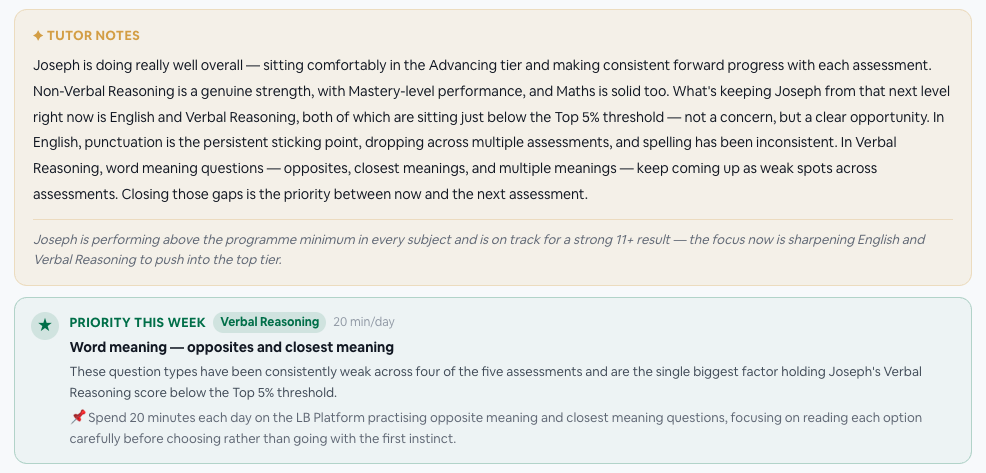
The dashboard turns assessment trends into a progress summary and a specific weekly priority, with the recommended subject, daily practice time, and an actionable next step.
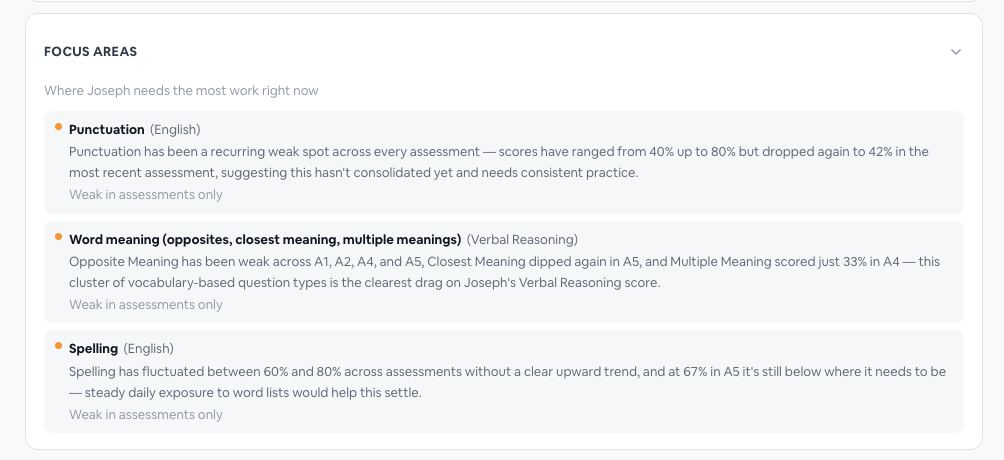
Subject and topic recommendations explain patterns across assessment results, identify recurring weaknesses, and distinguish assessment-only evidence from practice activity.

The generated parent message translates student progress into plain language and suggests a concrete activity to support learning at home.
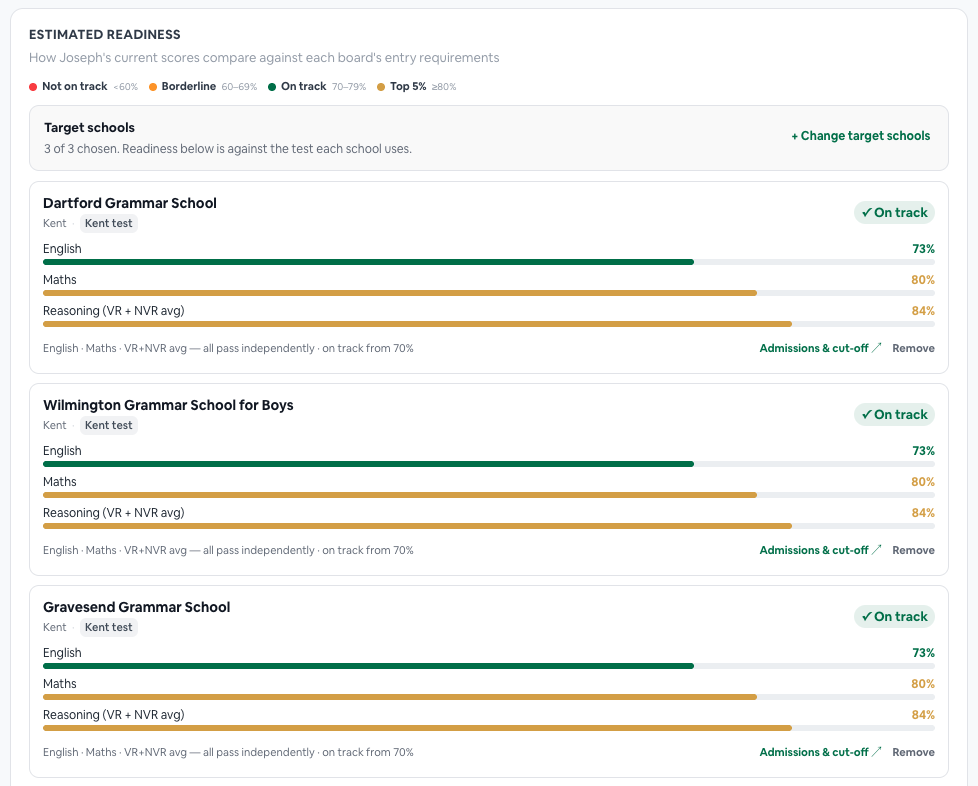
Alongside the AI feedback, the dashboard compares subject scores against the tests used by selected schools. This assessment-based view provides context for progress and clearly distinguishes test readiness from an admissions offer.
Learning activity and assessment results live across different platforms. The goal was to bring that data together and turn it into understandable student performance feedback, so parents could follow progress through the product.
My contribution
I built both the frontend and the API integration behind the feedback workflow. This work connects full-stack application engineering with an AI feature inside an educational product.
Built the product interface and connected feedback to the parent dashboard. AcademicTrack supports separate parent, tutor, and admin applications in a TypeScript monorepo with shared backend logic.
Implemented the API integration behind the feedback workflow. Thinkific practice activity and Brillium assessment results feed a shared Neon PostgreSQL data layer, with assessment history scoped by academic year.
Integrated the Anthropic Claude API to produce progress summaries, subject and topic focus areas, parent messages, and weekly study priorities. Prompts combine assessment trends with practice weaknesses and request structured JSON.
Built scheduled data synchronization for student progress reporting. GitHub Actions runs the longer Thinkific sync and chains AI generation after a successful run; Vercel provides serverless application routes and cron entry points.
System overview
A high-level view of the feedback workflow, from learning and assessment data to the parent-facing experience.
01
Thinkific practice + Brillium results
02
Scheduled sync + Neon PostgreSQL
03
Year-scoped context + Claude API
04
JSON outputs + input hash + model version
05
Parent, tutor, and admin dashboards
Reliability & controls
The feedback pipeline includes controls for external API limits, model output, generation cost, and student data handling.
The feedback pipeline substitutes a name placeholder before sending the prompt to Claude, then restores the first name locally in the returned content.
Claude calls retry rate-limit failures with exponential backoff and jitter. Small batches and delays control the generation workload.
The pipeline strips code fences, parses the JSON response, and requests one fresh generation if parsing fails before storing the feedback.
An input hash skips Claude regeneration when student data is unchanged. Administrators can select the model, set an output-token limit, and disable AI generation.
Sync records capture success, partial failure, errors, counts, and duration. Admin views surface AI run health; stored feedback includes generation timestamps and model versions.
Feedback uses the student’s latest academic year and filters assessment sections to sittings completed in that year, keeping older results out of current progress commentary.
Architecture decisions
Feedback is generated ahead of time and stored in PostgreSQL for dashboard reads. This keeps the nightly feedback workflow separate from the parent’s page request, with updates following the synchronization cycle.
The repository runs longer Thinkific imports and chained AI generation on GitHub Actions runners to accommodate external API limits and work that exceeds serverless execution windows.
Prompts cross-reference formal assessment weaknesses with practice activity. Weekly focus-topic rotation also uses deterministic backend rules and topic history, rather than relying entirely on model-generated recommendations.
Development workflow
Engineering tool
I used Claude Code for implementation, debugging, refactoring, and testing while developing Limit Breakers. It supported my work across the product interface and backend API integration.
Application integration
I implemented the API integration that generates student performance feedback from assessment data. Claude is part of the application’s feedback workflow, connected through the backend and surfaced in the product.
The integration brings learning data, assessment results, and AI-generated feedback into student progress reporting. It demonstrates my work across frontend delivery, backend integrations, scheduled workflows, and Claude-powered product features.
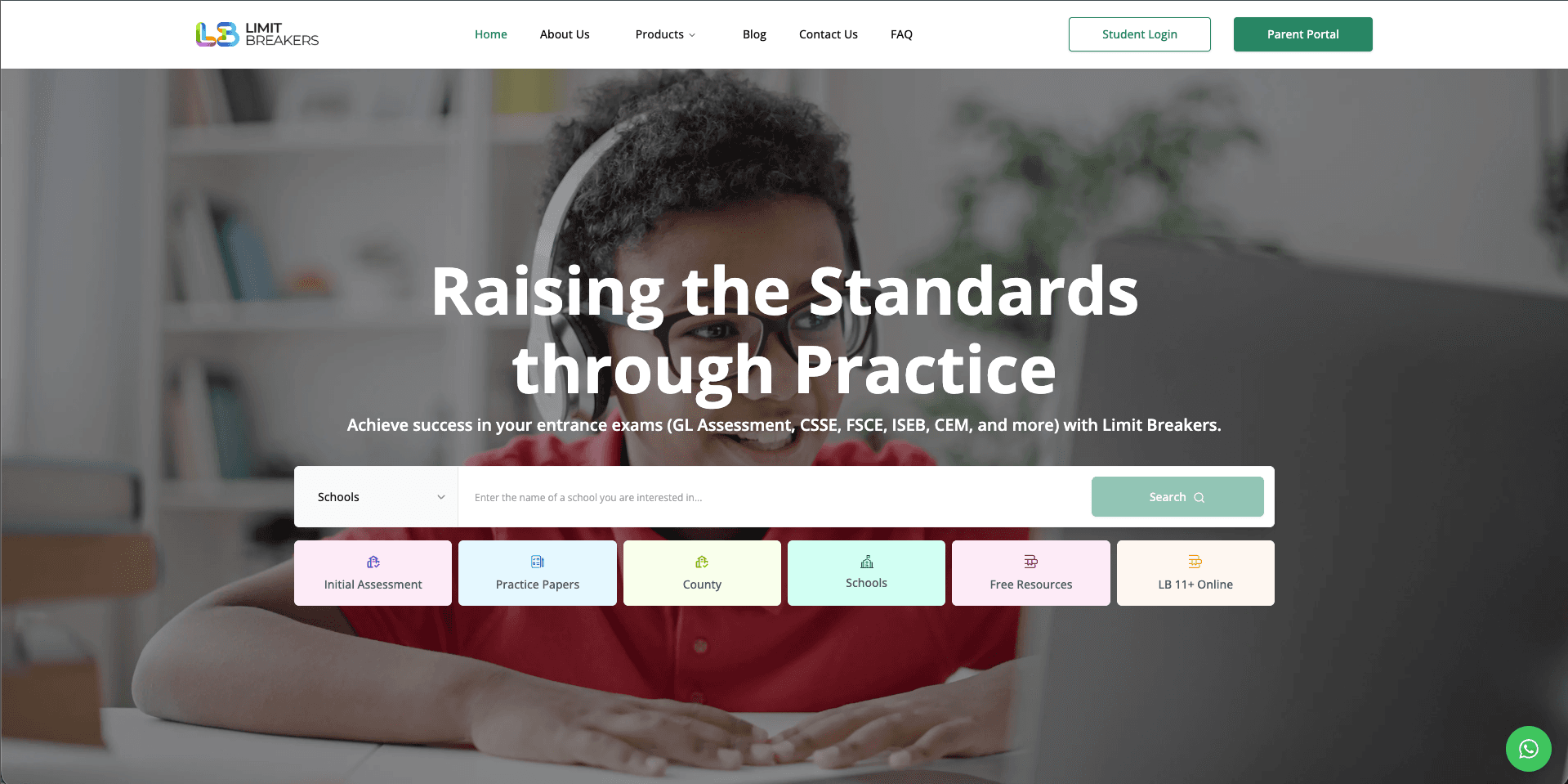
The public website introduces the educational platform. Student reports and the parent dashboard require account access.